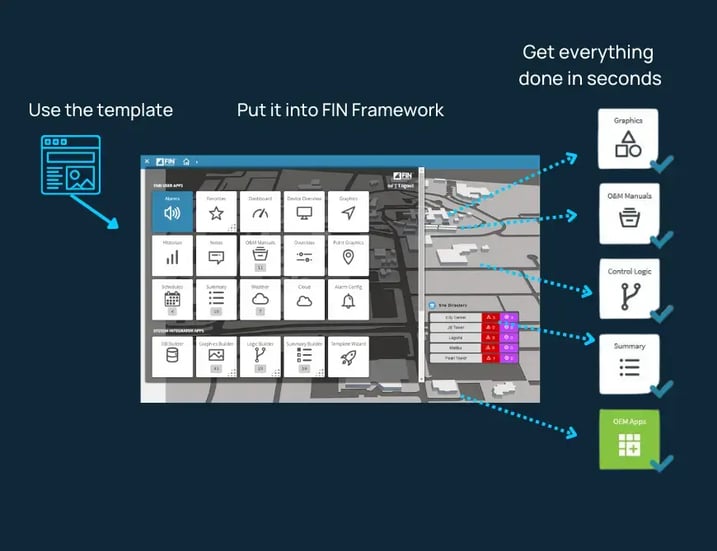
For the last decade, FIN Framework has leveraged Project Haystack and the use of tags to add metadata to project databases to create efficiency gains and user experience payoffs. Part of the secret sauce behind the scenes that system integrators have leveraged is the use of FIN templates and point libraries. By using templates everything gets done (graphics, O&M Manuals, Logic, and Summaries) in seconds instead of hours because the applications leverage metadata.
These templates depended on Haystack tagging, which meant that marker tags and relationship tags were applied properly to a project database. If the correct tags were present, the workflows went smoothly and the job was complete and functional. In practice, sometimes engineers who created the database had a fair amount of leeway in how they interpreted the Project Haystack documented standard.
That approach raised an important but often unspoken set of questions. Were the applied tags complete? Were they accurate? Were they sufficient for the application trying to use them? In many cases, the answers depended less on the data itself and more on the experience of the person implemented it.
At the same time, the Haystack community was navigating a fundamental tension. On one side was the need to maintain flexibility, extensibility, and a low barrier to getting started using metadata. On the other hand, there was the growing demand for consistent usage, predictable behaviour, and true interoperability across tools, vendors, and applications.
Those objectives naturally compete with each other. Too much rigidity slows adoption. Too much flexibility undermines consistency. The lesson learned over time is that tagging alone cannot resolve that tension.
Validation is what makes it possible to satisfy both. It preserves Haystack’s flexibility while providing a clear mechanism to confirm that tags are complete, accurate, and fit for purpose. With validation, interoperability becomes something that can be verified rather than simply the interpretation of the data standard. What’s emerging now is an open ecosystem that looks very different from where Haystack started.
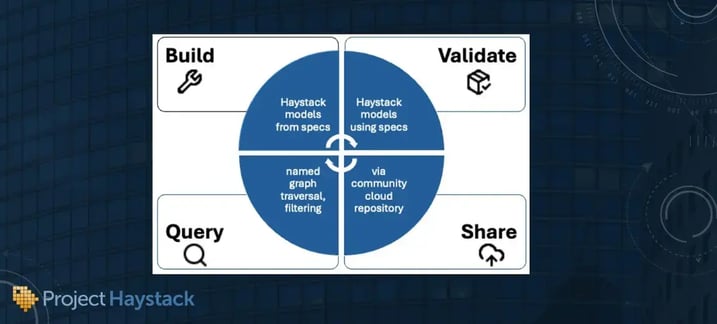
Today, the Haystack community is actively developing Haystack 5 and tools like Xeto to close the gap between intent and outcome. Validation addresses a long-standing challenge in the ecosystem: the reality that tags have historically been applied and extended differently by different people, often with good intentions but inconsistent results.
By introducing validation, Haystack tagging relies less on manual interpretation and more on programatic implementation of data model standards. Teams can now confirm that data meets shared expectations before it is consumed by applications. That shift is what unlocks interoperability in a practical sense.
Looking ahead, the openness of the ecosystem becomes even more important. As Haystack enables more native support for RDF, developers and building owners are no longer constrained by a single semantic approach. Buildings modeled with Haystack are positioned to interoperate with other RDF-native semantic web technologies rather than being isolated from them.
This future is intentionally open. Haystack, Xeto, Haxall, and related tooling are all open source, allowing innovation to happen across vendors, disciplines, and use cases. The goal is not to replace flexibility with rigidity, but to pair flexibility with validation so that open systems can scale without losing consistency.
If you'd like to learn more about exciting changes with Project Haystack, check out this webinar that introduces Haystack 5 and Xeto.
With FIN Framework, our superpower has always been leveraging tagging and metadata to create amazing payoffs for users of our application suite. J2 Innovations has provided pre-engineered point libraries and OEM specific templates to define/model points and equipment for projects. We look forward to the day when there is a vibrant community of partners contributing to a unified standard.
As Project Haystack continues to evolve and the Haystack 5 Standard continues to be adopted, enabling technologies such as Xeto will help provide the technology to deliver standardized data models, and most importantly a way to validate those models in an open ecosystem.


Topics from this blog: Project Haystack Smart Buildings Smart Equipment FIN Framework Technology Project Engineering Building Automation System BAS
Back to all posts